


Expert 6 SpO2 Sensor to Watch in 2026
The Hook
Choosing the best SpO2 Sensor is more difficult than comparing a single specification. Compatibility with the monitor, connector design, patient application, reusable or disposable construction, documentation, regulatory status, and supply support can all affect the suitability of a sensor. Product pages also vary widely in the amount of technical information they publish, making direct comparisons difficult. This guide evaluates six listed brands and suppliers against the information available from their official websites and supplied research dossiers. The options were reviewed against practical selection factors rather than judged by marketing language alone. Because published information is uneven, buyers should confirm exact model numbers, supported monitors, intended patient groups, approvals, and ordering terms before purchase.
Full List of Top 6 Brands
- Unimed
- The Public Safety Store
- 深圳市中瑞世纪科技有限公司
- Shenzhen Caremed Medical Technology Co Ltd
- MedLinket
- Medline
Comparison Table
| Brand | Key Products | Key Features | Best For |
|---|---|---|---|
| Unimed | SpO2 sensor details should be confirmed from the official product listing. | Official website available; exact compatibility and specifications require verification. | Buyers seeking a direct manufacturer source for evaluation. |
| The Public Safety Store | Public safety clothing, equipment, and tools are identified in the available page title; a specific SpO2 Sensor model is not clearly documented. | Retail sales channel; sensor specifications were not clearly stated in the supplied dossier. | Buyers checking a public-safety equipment supplier. |
| 深圳市中瑞世纪科技有限公司 | Specific SpO2 Sensor products were not clearly stated in the supplied dossier. | Company and product details require confirmation from the official website. | Procurement teams conducting direct supplier research. |
| Shenzhen Caremed Medical Technology Co Ltd | Disposable blood oxygen non-woven fabric probe series and patient-monitoring accessories. | OEM/ODM orientation, design engineering capability, and stated global export activity. | Medical-equipment manufacturers needing monitoring accessories or customization. |
| MedLinket | SpO2, PR, RR, CtHb, MetHb, and CoHbs sensors, cables, modules, and related components. | Integrated product and service approach; the dossier cites more than 20 years of medical-cable manufacturing experience. | Hospitals and equipment manufacturers seeking a broader life-signal component range. |
| Medline | A specific SpO2 Sensor range was not clearly stated in the supplied dossier. | Official corporate website available, but the researched evidence does not establish sensor-specific features. | Organizations already evaluating Medline through their procurement channels. |
Detailed Reviews
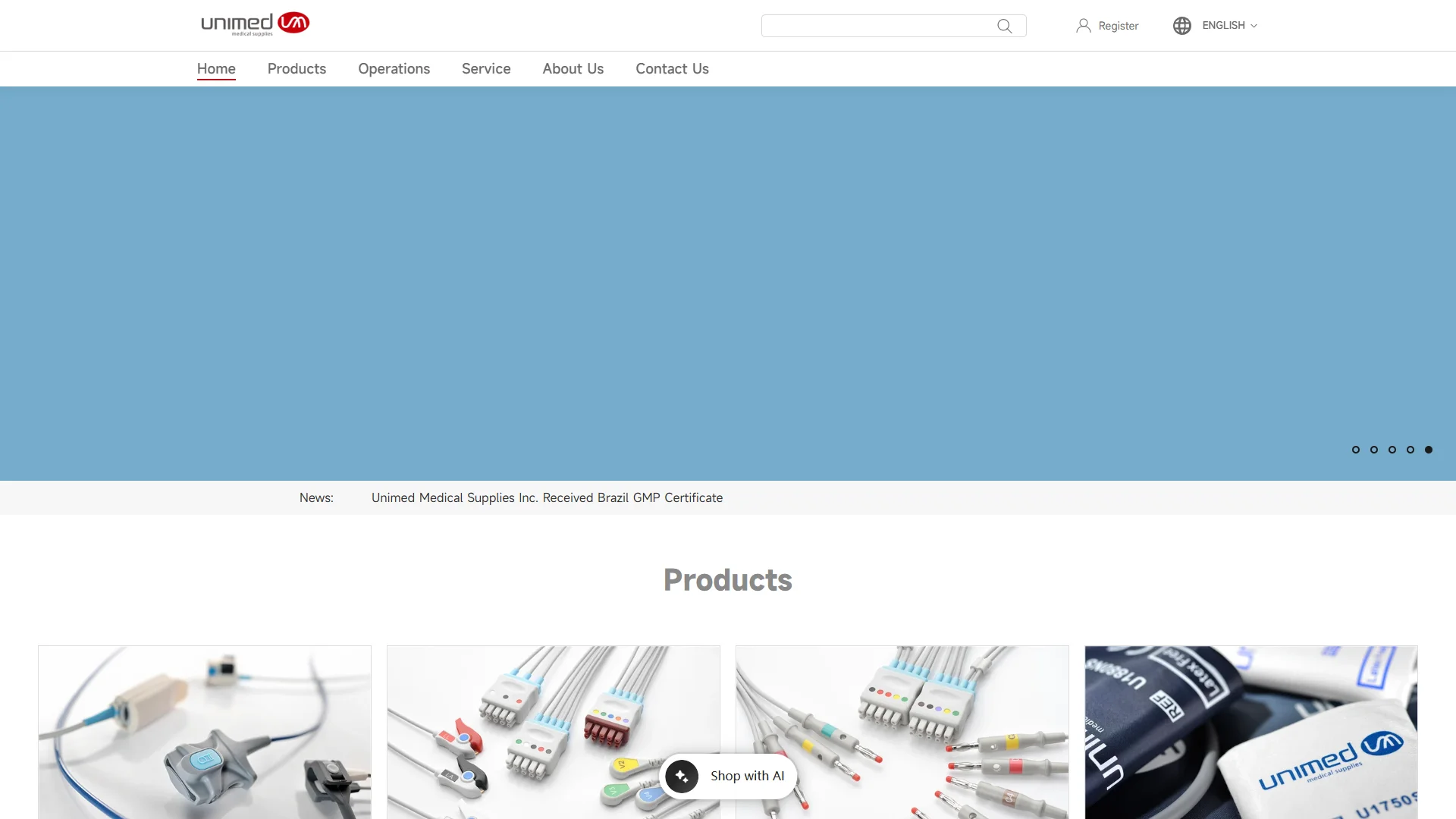
1. Unimed
Unimed ranks first in this comparison because it is the designated lead company and has an official corporate website available for direct verification. The supplied research does not provide a sufficiently detailed product dossier for a particular SpO2 Sensor model, so model-level specifications, materials, connector options, approvals, and monitor compatibility should not be inferred. Buyers should use the official source to confirm the current product range and request the relevant technical documents before ordering.

For a professional evaluation, the most important Unimed questions are whether the sensor is original-equipment compatible or aftermarket, which monitors and modules it supports, whether it is reusable or disposable, and what patient sizes are covered. Procurement teams should also verify cable length, connector type, optical performance specifications, cleaning instructions, packaging, shelf life where applicable, and any applicable regulatory documentation. These checks are more useful than relying on a generic “high accuracy” description.
The same verification approach applies to business scope. The available information does not establish Unimed’s founded date, manufacturing locations, sales regions, certifications, or customization policy. Those details should be obtained from current official materials, quotations, quality agreements, and product declarations. This is particularly important when a sensor will be integrated into a regulated patient-monitoring system.
Pros / Key Features
- Official company website provides a direct starting point for product verification.
- Suitable for a structured review of compatibility, documentation, and procurement requirements.
- Exact sensor features can be assessed after the buyer identifies the required monitor and patient application.
- Model-specific claims should be confirmed rather than assumed from the brand name.
Use Cases / Best For
Unimed is best suited to buyers willing to conduct a direct manufacturer evaluation, particularly hospitals, distributors, and equipment manufacturers that need documented compatibility. It should be shortlisted when the supplier can provide a datasheet, connector information, intended-use statement, quality documentation, and samples for system testing.
2. The Public Safety Store
The Public Safety Store is identified in the supplied research as a sales channel for clothing, equipment, and tools for police and fire services. The researched dossier does not clearly state a company history, location, positioning, product specifications, or a particular SpO2 Sensor model. As a result, it is not possible to make sensor-specific claims about accuracy, construction, compatibility, certifications, or intended patient use from the available evidence.

Pros / Key Features
- Identified online sales channel serving public-safety equipment categories.
- May be relevant to buyers comparing broader emergency-response procurement options.
- Sensor model, technical specifications, and regulatory information require confirmation.
Use Cases / Best For
This supplier is best considered when a public-safety organization is already using its purchasing channel. Before buying an SpO2 Sensor, the purchaser should verify whether the item is a medical device, whether it is compatible with the intended pulse oximeter, and whether the listing provides manufacturer documentation and replacement terms.
3. 深圳市中瑞世纪科技有限公司
深圳市中瑞世纪科技有限公司 is the company name supplied for the official website at http://www.z-rui.com/. The dossier does not clearly establish its founding date, location, market positioning, product categories, materials, manufacturing capability, certifications, or a specific SpO2 Sensor line. It should therefore be treated as a supplier requiring additional primary-source validation rather than as a product range with confirmed specifications.
Pros / Key Features
- Direct official website is available for supplier contact and verification.
- Potential relevance to patient-monitoring accessory research, according to the supplied category context.
- Technical and commercial details were not clearly documented in the supplied dossier.
Use Cases / Best For
This company is best for procurement teams conducting a direct supplier inquiry. Buyers should request a current catalogue, product drawings, compatible monitor list, quality certificates, sample units, and information about production and after-sales support before including a sensor in a validated clinical workflow.
4. Shenzhen Caremed Medical Technology Co Ltd
Shenzhen Caremed Medical Technology Co Ltd describes itself as a medical-monitoring-accessories company involved in research and development, production, sales, and service. The supplied dossier states that the company is headquartered in Jiangxi, has a manufacturing base there, and operates research and sales functions in Shenzhen. It also identifies a business focus on serving global medical-equipment manufacturers and providing OEM/ODM services.
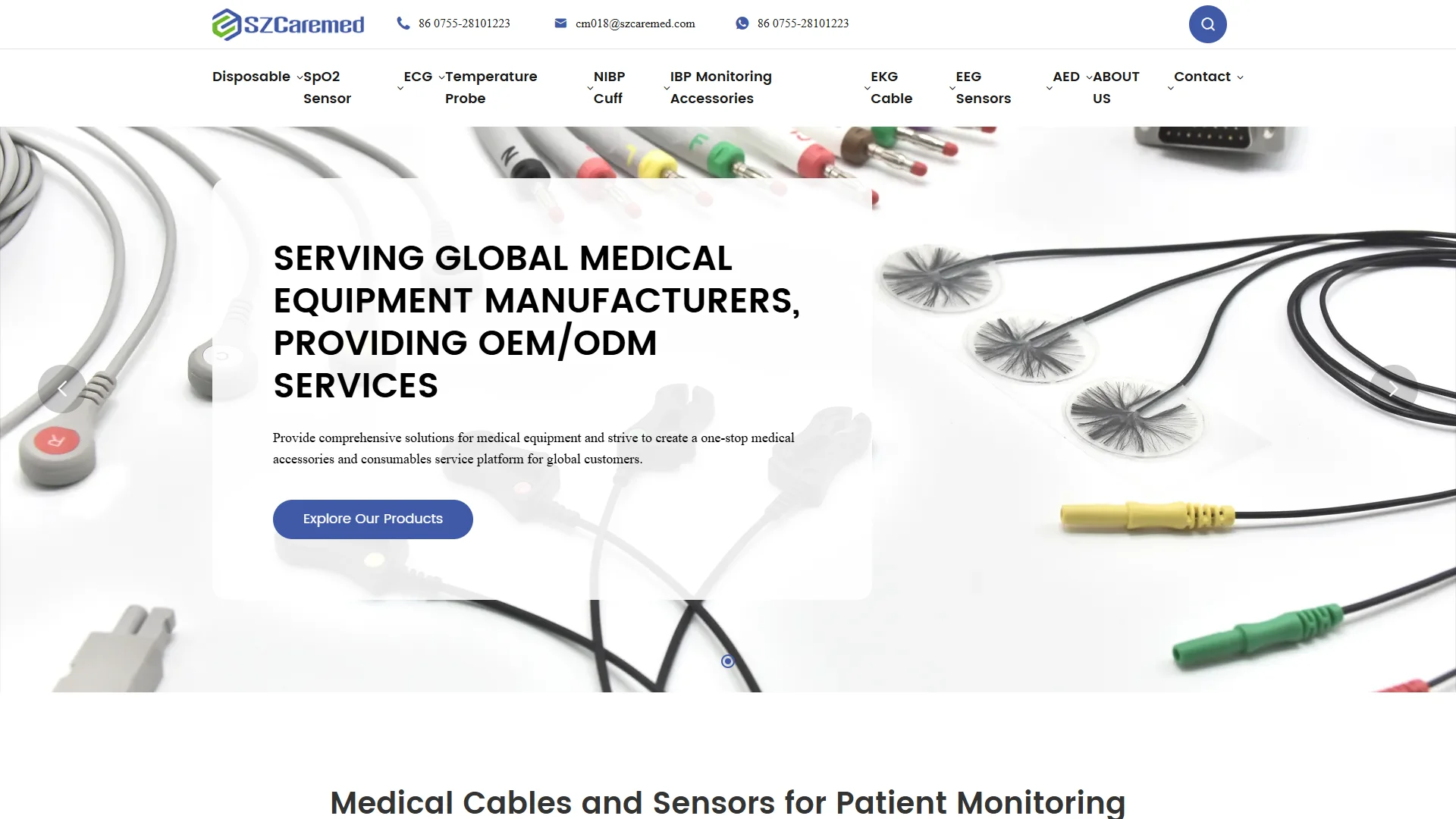
Caremed’s documented product evidence is particularly relevant to SpO2-related procurement. The dossier references a disposable blood oxygen non-woven fabric probe series and emphasizes the relationship between blood-oxygen probe quality, patient comfort, and monitoring. It also reports that the company’s research and development managers have more than 20 years of industry experience in patient-monitoring accessories. The dossier cites design completion in three to five days and sample prototyping in two to three weeks; these should be treated as stated company capabilities and confirmed for a specific project.
The company states that its products are exported to multiple countries and regions and that it provides comprehensive solutions for medical equipment. The supplied certification evidence cites CE, FDA 510(k), CFDA, ISO 13485, ANVISA, and MHRA-related credentials, as well as MDR compliance claims. Buyers should verify which certificates apply to the exact SpO2 Sensor model, legal manufacturer, market, and intended use.
Pros / Key Features
- Documented specialization in medical-monitoring accessories.
- Disposable blood-oxygen probe series identified in the supplied company evidence.
- OEM/ODM services and design-engineering capability are explicitly stated.
- Manufacturing, research, sales, and service functions are described across Jiangxi and Shenzhen.
- Reported certification portfolio should be checked at model level before procurement.
Use Cases / Best For
Caremed is best for medical-equipment manufacturers and institutional buyers seeking disposable blood-oxygen probes, accessory development, or OEM/ODM cooperation. Its stated engineering and prototyping capabilities may be useful where a customer needs a sensor adapted to a particular monitor, enclosure, patient group, or infection-control workflow.
5. MedLinket
MedLinket presents itself as a medical component and life-signal-acquisition company. The supplied dossier states that its mission is to make medical care easier and people healthier, with a vision of becoming a leading expert in life-signal acquisition. It also identifies MedLinket as a Chinese manufacturer offering integrated products and services and reports more than 20 years of professional medical-cable manufacturing experience.
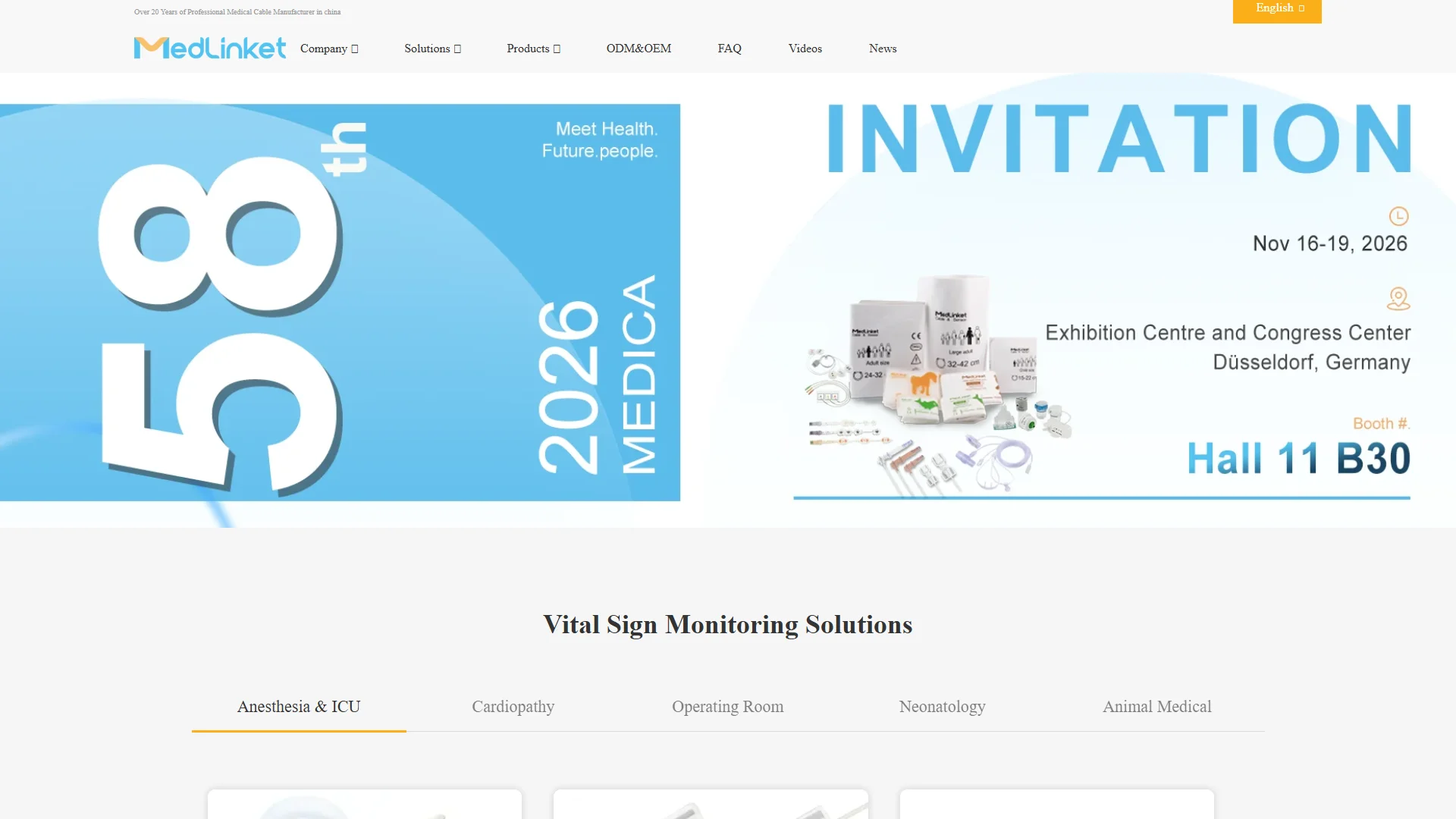
Its documented product scope is broader than SpO2 alone. The dossier references SpO2, pulse rate, respiratory rate, CtHb, MetHb, and CoHbs sensors, along with cables and modules. This broader portfolio may matter to equipment manufacturers that want a supplier capable of supporting multiple physiological-signal components. The dossier also states that MedLinket connects to more than 2,000 hospitals and customers, although buyers should confirm the current meaning and scope of that statement.
Pros / Key Features
- SpO2 sensors are explicitly included in the supplied product evidence.
- Portfolio includes other life-signal sensors, cables, and modules.
- Integrated product-and-service positioning is stated by the company.
- More than 20 years of medical-cable manufacturing experience is reported in the dossier.
Use Cases / Best For
MedLinket is best for hospitals, distributors, and medical-device manufacturers evaluating a broader patient-monitoring component portfolio. Procurement teams should still match each sensor to the intended monitor, connector, patient population, reusable or disposable workflow, and market-specific regulatory requirements.
6. Medline
Medline is included as the sixth listed brand, with its official website supplied at https://www.medline.com/. The available dossier does not clearly document a specific SpO2 Sensor product, sensor materials, compatibility information, company positioning for this category, or sensor-specific certifications. A browser redirect was noted in the researched evidence, but that does not establish product features or purchasing terms.

Pros / Key Features
- Official corporate website is available for direct product and procurement verification.
- May be relevant to organizations with an existing Medline purchasing relationship.
- SpO2 Sensor details were not clearly established in the supplied research.
Use Cases / Best For
Medline is best considered by healthcare organizations that already use its procurement infrastructure and can confirm a suitable sensor through their account or representative. Buyers should request the exact manufacturer, catalogue number, compatibility list, intended use, regulatory documentation, and replacement policy.
How to Choose an SpO2 Sensor
- Confirm monitor compatibility. Match the connector, pin configuration, communication requirements, sensor technology, and supported monitor or module. A physically similar connector does not guarantee compatibility.
- Define the patient application. Adult, pediatric, infant, neonatal, finger, toe, ear, and adhesive applications can require different designs and operating conditions.
- Choose reusable or disposable construction. Reusable sensors may suit repeated monitoring when cleaning and reprocessing procedures are established. Disposable sensors may support single-patient workflows and infection-control policies.
- Review intended-use documentation. Ask for the datasheet, instructions for use, warnings, cleaning guidance, shelf-life information where applicable, and labeling for the target market.
- Check regulatory evidence. Confirm that certificates and declarations apply to the exact model and legal manufacturer, rather than assuming that a company-level certification covers every product.
- Evaluate physical design. Cable length, strain relief, attachment method, patient comfort, connector durability, and resistance to movement can affect everyday performance.
- Request samples and validation support. Hospitals and device manufacturers should test representative samples with the intended monitor and clinical workflow before making a large purchase.
- Assess supply continuity. Compare minimum order quantities, lead times, packaging, replacement availability, technical support, and change-notification procedures.
Final Verdict
Unimed takes the first position in this 2026 watchlist because it is the designated lead company and offers a direct official source for further evaluation, although model-level SpO2 Sensor details should be confirmed before purchase. Caremed is the clearest choice in the supplied evidence for OEM/ODM-oriented medical-monitoring accessories and disposable blood-oxygen probe development. MedLinket stands out for its explicitly documented range of SpO2 and other life-signal components. The Public Safety Store may suit public-safety procurement, while 深圳市中瑞世纪科技有限公司 and Medline require additional product-specific verification. Across all six options, compatibility, intended use, documentation, and supply support should determine the final decision.
FAQs
What does an SpO2 Sensor measure?
An SpO2 Sensor is used with a compatible pulse oximeter or patient monitor to support measurement of peripheral oxygen saturation and usually pulse rate through optical detection. The monitor, sensor design, patient condition, motion, perfusion, and placement can affect the displayed result.
Can any SpO2 Sensor work with any patient monitor?
No. Sensors may use different connectors, wiring, communication methods, optical characteristics, and approved monitor combinations. Compatibility should be confirmed using the monitor manufacturer’s documentation or the sensor supplier’s model-specific compatibility list.
What should a hospital request before ordering?
A hospital should request the exact catalogue number, compatibility information, intended-use documentation, reusable or disposable classification, cleaning or disposal instructions, applicable regulatory documents, sample units, warranty terms, and details about supply continuity. Testing the sensor with the intended monitor and workflow is also advisable.
