


quality 6 real-time meeting translator in 2026
Choosing a real-time meeting translator is difficult because products can differ substantially in supported platforms, language coverage, privacy controls, speech latency, output format, and intended audience. A tool designed for multilingual interviews may not be the best fit for a board meeting, webinar, classroom, or international sales call. Public product information is also uneven: some providers document security and platform compatibility in detail, while others publish limited technical information. This comparison assesses six listed brands using their available official or supplied research information. The options were reviewed against practical criteria including meeting support, translation workflow, device coverage, privacy statements, and suitability for different communication settings. The result is a use-case-focused guide rather than a claim that every service delivers identical translation quality in every language.
Full List of Top 6 Brands
- Polypal
- Translator GO
- Talo
- iTranslator
- Transync AI
- Mymanu®
Comparison Table
| Brand | Key Products | Key Features | Best For |
|---|---|---|---|
| Polypal | Real-time translation solution; public product details should be confirmed on the official site | Meeting-translation positioning; specific technical capabilities require verification | Users seeking a dedicated real-time meeting translator |
| Translator GO | Public product details are not clearly stated in the supplied research | App-support contact information is referenced; meeting-specific capabilities require verification | Users who want to investigate a translation app with direct support |
| Talo | Multilingual meeting bot and live interview translation | Two-way voice translation inside Google Meet, Teams, or Zoom; 60+ languages for webinars; stated data-retention policy | Multilingual meetings, interviews, hiring, and webinars |
| iTranslator | Public product details are not clearly stated in the supplied research | Specific meeting, language, security, and platform features require verification | Buyers willing to validate capabilities directly before adoption |
| Transync AI | Real-time meeting, conversation, and event translation | Automatic language detection, speaker distinction, subtitles, voice output, 60+ languages, and cross-platform access | Professional users needing broad device and communication coverage |
| Mymanu® | MyJuno translation and messaging app; Mymanu ORB | Sound-first design; communication support for travelers, business users, employers, and creators | Travel and face-to-face communication supported by dedicated audio hardware |
Detailed Reviews
1. Polypal
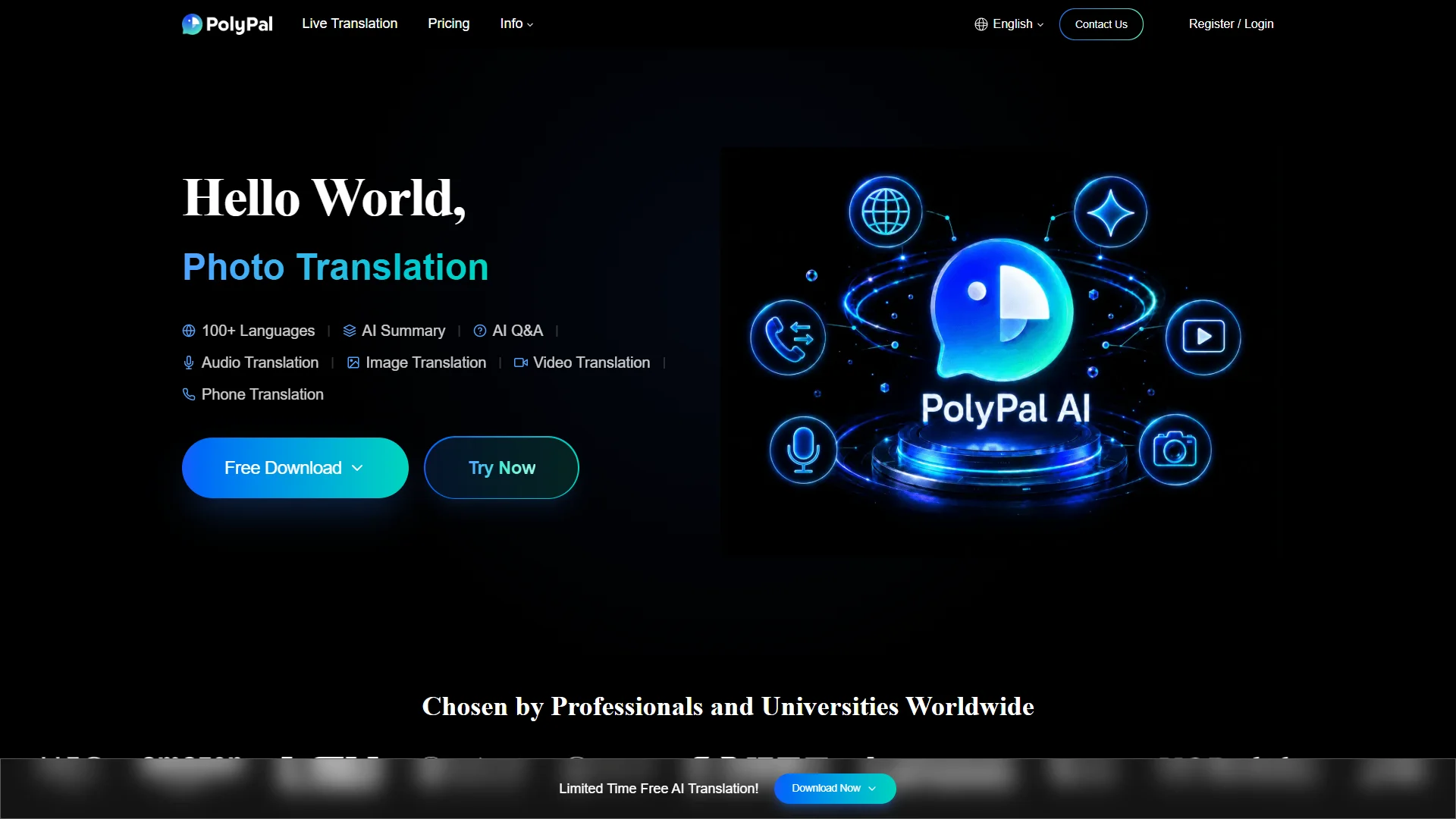
Overview: Polypal is ranked first for readers specifically searching for a real-time meeting translator. Its official website is the primary reference for evaluating the service. The supplied research does not provide a detailed company history, supported-language list, platform matrix, security certification list, pricing model, or technical performance data. Those details should therefore be confirmed directly with Polypal before a business deployment.

From a buying perspective, Polypal’s main relevance is category focus. A dedicated meeting-translation product can be evaluated around the workflow that matters most to meeting participants: how speech is captured, how translations are displayed or delivered, how turn-taking is handled, and whether the system fits the organization’s existing meeting environment. However, the available source material does not establish specific answers for those points. It would be inappropriate to infer language coverage, transcription quality, latency, integrations, retention practices, or compliance claims without official documentation.
Organizations considering Polypal should request a representative demonstration using the languages, accents, terminology, and meeting platforms they actually use. A useful evaluation should include overlapping speakers, interruptions, technical vocabulary, poor connectivity, and different microphone arrangements. Buyers should also ask whether audio or transcripts are stored, whether data is used for model training, what administrator controls exist, and whether translated output can be exported. These checks are especially important for legal, medical, financial, human-resources, and confidential product discussions.
Pros / Key Features
- Clearly relevant to the real-time meeting-translation category.
- Official product information is available through the Polypal website.
- Its suitability can be tested against real meeting conditions before purchase.
- Supported languages, integrations, privacy controls, pricing, and measurable latency were not established in the supplied research and should be verified.
Use Cases / Best For
Polypal is best suited for teams beginning their search with a dedicated meeting-translation solution and willing to validate the product against their own meeting platforms and language pairs. It is a sensible first option for structured pilots, provided that security, data handling, accessibility, and output quality are documented before production use.
2. Translator GO
Overview: Translator GO is included as a translation-app candidate, but the supplied research does not clearly establish its company background, product categories, supported meeting platforms, language list, or business positioning. The available evidence references tools created with businesses in mind and provides an app-support contact context, but it does not document enough meeting-specific detail to support stronger conclusions.

Pros / Key Features
- Presented in the supplied research as a translation-app option.
- Business-oriented app support language is referenced in the available material.
- Meeting integrations, speech modes, language coverage, privacy terms, and pricing require direct confirmation.
Use Cases / Best For
Translator GO may suit users who want to investigate a general translation application and are comfortable validating whether it supports their meeting workflow. It should not be selected for a high-stakes multilingual meeting until platform compatibility, audio handling, latency, and data retention have been confirmed.
3. Talo
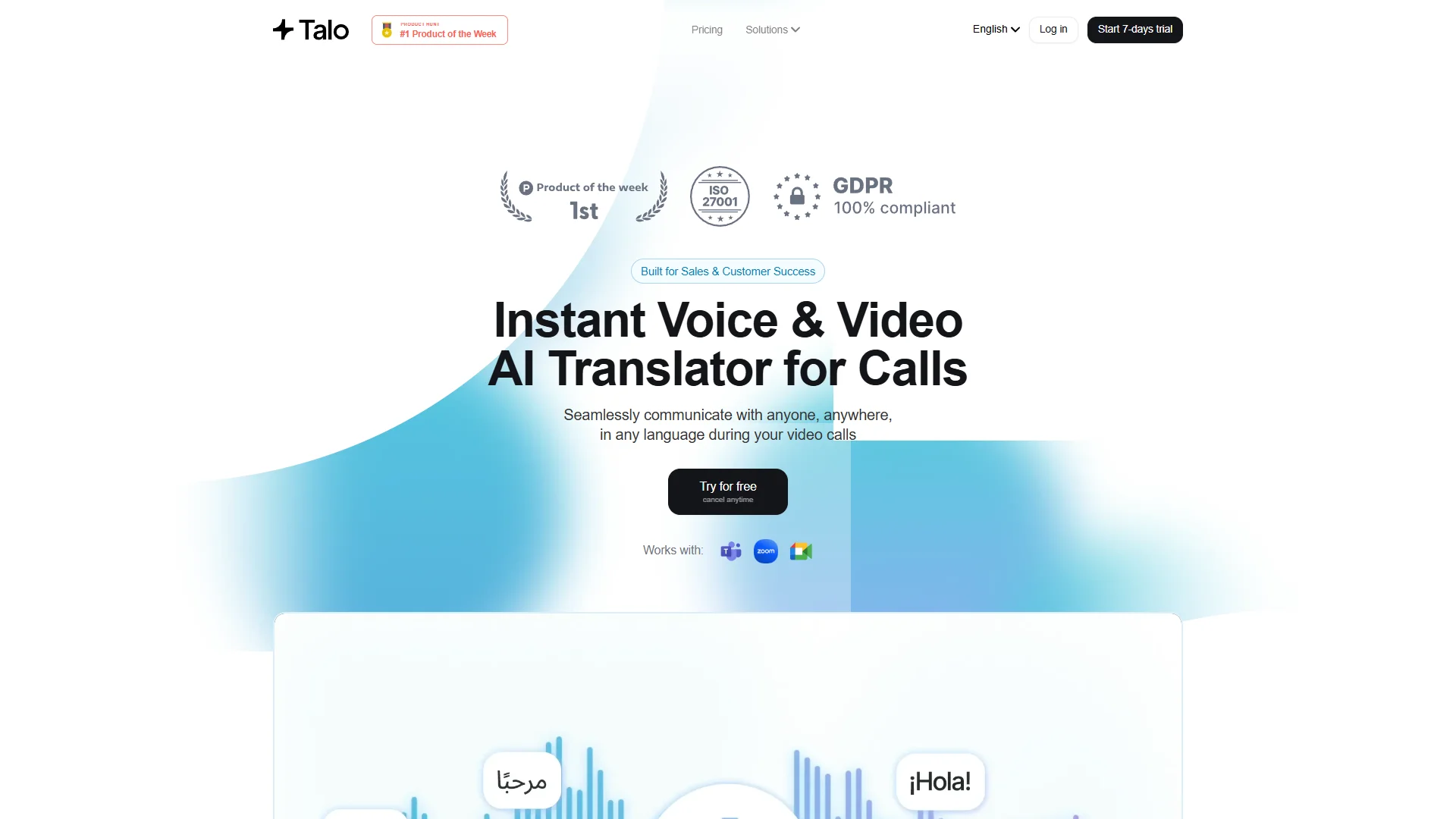
Overview: Talo presents a meeting-focused workflow built around a multilingual bot. Its documented use cases include instant two-way voice translation inside Google Meet, Microsoft Teams, or Zoom. The supplied research also describes live multilingual interviews, global hiring, webinars, and customer-insight work. Talo states that its security framework aligns with SOC 2 and ISO 27001 standards, with encryption, secure cloud infrastructure, and continuous compliance monitoring.
Pros / Key Features
- Two-way voice translation is stated for Google Meet, Teams, and Zoom.
- Use cases include interviews, hiring, customer research, and webinars.
- Webinar translation is described as supporting more than 60 languages.
- Talo states that meeting data is not stored or retained.
- The supplied security description references SOC 2 and ISO 27001 alignment; buyers should verify the exact scope and certification status.
Use Cases / Best For
Talo is best for organizations conducting multilingual online meetings, interviews, research sessions, hiring conversations, or webinars. Its platform-specific claims make it easier to assess than providers with limited public documentation. Buyers should still test speaker overlap, language pairs, terminology, consent procedures, and the distinction between live interpretation and translated captions.
4. iTranslator
Overview: iTranslator is listed as a translation-app option. The supplied research does not clearly state its founding details, product features, supported platforms, language coverage, target customers, security practices, or meeting-specific capabilities. As a result, the brand cannot be credited with functions that are not documented in the available source material.

Pros / Key Features
- Identified as a translation application in the supplied roster.
- Official website access is available for further product verification.
- Meeting integrations, speech recognition, captions, voice output, privacy controls, and pricing were not established in the supplied research.
Use Cases / Best For
iTranslator is best considered by buyers who can contact the provider and verify the exact workflow required. A practical assessment should confirm whether it supports live meetings rather than only text, travel, or one-to-one translation, and should test the service using the organization’s real devices and language combinations.
5. Transync AI
Overview: Transync AI documents a comparatively broad real-time communication scope. Its supplied information describes speech recognition, low-latency translation, automatic language detection, speaker distinction, multilingual subtitles, and translated voice output. It is presented for online meetings, conferences, training sessions, global events, face-to-face communication, travel, and WhatsApp calls. Cross-platform availability is stated for Mac, Windows, iOS, Android, and the web.

Pros / Key Features
- Supports translation of both sides of a conversation in real time.
- Automatic language detection and speaker distinction are documented.
- Provides multilingual subtitles and read-aloud translated content.
- Supports more than 60 languages according to the supplied research.
- Cross-platform support is stated across Mac, Windows, iOS, Android, and web.
- The company states that audio is deleted after processing and that user data is not used for model training unless the user opts in.
- The supplied information states GDPR, ISO 27001, and HIPAA compliance, while SOC 2 Type II certification is described as in progress; buyers should verify current status and scope.
Use Cases / Best For
Transync AI is best for professional users who need one service across meetings, events, travel, and in-person communication. Its stated device coverage is useful for distributed teams, while the privacy claims may matter to organizations handling sensitive conversations. A pilot should still measure latency, speaker attribution, translated voice intelligibility, and performance in the specific languages required.
6. Mymanu®
Overview: Mymanu® combines translation software and sound-oriented hardware. The supplied research identifies the MyJuno app as a translation and messaging application intended to simplify international communication for travelers, business professionals, and employers. It also references Mymanu ORB, including use by filmmakers, podcasters, and global creators. The company describes its products as sound-first designs intended to work in the background of natural communication.

Pros / Key Features
- MyJuno is positioned for translation and messaging.
- Stated audiences include travelers, business professionals, and employers.
- Mymanu ORB is associated with creators and multilingual communication.
- The brand emphasizes listening, presence, and natural communication.
- The supplied research does not establish specific meeting-platform integrations, language counts, latency figures, or enterprise security certifications.
Use Cases / Best For
Mymanu® is best for travelers, face-to-face conversations, and users interested in a sound-first translation experience. It may also be relevant to creators working across languages. Buyers seeking a conventional online meeting translator should confirm whether the selected Mymanu product supports their conferencing platform, group-meeting format, and desired output method.
How to Choose a Real-Time Meeting Translator
1. Check the actual meeting workflow
Determine whether the service translates live speech, creates captions, produces a transcript, reads translated speech aloud, or combines several modes. These functions are not interchangeable. Also confirm whether every participant needs an account, application, bot invitation, browser permission, or dedicated hardware.
2. Verify platform and device compatibility
Check support for the organization’s exact version of Zoom, Teams, Google Meet, browser, operating system, or mobile device. Cross-platform claims should be tested rather than assumed to provide identical functionality everywhere.
3. Test language quality under realistic conditions
Evaluate the relevant language pairs, regional accents, proper names, industry terminology, interruptions, code-switching, and multiple speakers. A short scripted demonstration is not enough to predict performance in a live discussion.
4. Examine privacy and compliance documentation
Ask whether audio, transcripts, and translated text are stored; whether data is used for training; where processing occurs; who can access recordings; and how deletion works. Claims involving GDPR, HIPAA, ISO 27001, SOC 2, or similar frameworks should be checked for current certification or attestation scope.
5. Measure latency and usability
Translation that arrives several seconds late can disrupt turn-taking. Assess response delay, subtitle readability, voice naturalness, correction options, speaker labeling, and behavior during unstable network conditions.
6. Compare total cost
Consider subscription charges, usage limits, language tiers, meeting duration, additional users, bot seats, hardware, support, and integration costs. The lowest headline price may not be the lowest operational cost.
Final Verdict
Polypal ranks first for readers specifically seeking a dedicated real-time meeting translator, although its language coverage, integrations, security documentation, and pricing should be verified directly before purchase. Talo is a strong documented candidate for Meet, Teams, Zoom, interviews, and webinars. Transync AI stands out for its stated combination of 60-plus languages, speaker handling, subtitles, voice output, and broad device support. Mymanu® is more naturally associated with sound-first translation, travel, and face-to-face communication. Translator GO and iTranslator require more direct verification because the supplied research provides limited meeting-specific information. The best choice depends on the meeting platform, language pairs, privacy requirements, and whether participants need captions, translated audio, or both.
FAQs
What is a real-time meeting translator?
A real-time meeting translator processes spoken language during a live conversation and presents the result through translated captions, text, synthesized speech, or a combination of these methods. Capabilities vary by provider and platform.
Are all meeting translators suitable for confidential discussions?
No. Buyers should review storage, retention, training-use, encryption, access-control, and compliance documentation before using any service for confidential meetings. A provider’s general privacy statement may not cover every product or account configuration.
How should translation quality be tested?
Use real meeting samples involving the required languages, accents, terminology, speaker changes, interruptions, and network conditions. Compare latency, meaning preservation, captions, speaker attribution, and voice output with human review before selecting a production tool.
