


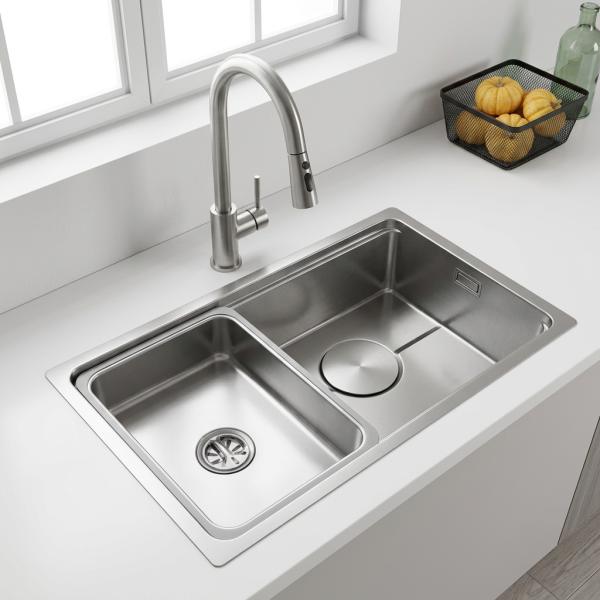
Which Questions Should You Ask Before Choosing a Stainless Steel Sink?
Opening: the problem that gets ignored
Choosing a sink looks simple until you install one that scratches, hums, or traps water in the wrong place. Ask the right questions before you buy: will this fit my workflow? will it last under frequent heavy use? who made it and can they support installation? These questions guide a practical decision, not a fashion choice, and they often lead buyers to consult kitchen sink manufacturers early in the project to avoid surprises.

What’s the daily problem you actually need solved?
Start by describing your worst-case day. Do you rinse large pots constantly? Do dirty dishes wait hours in the basin? Does your countertop need a flush, clean rim? Each scenario maps to a design requirement. If large pans dominate, prioritize a deep single bowl. If food prep and dishwashing alternate, consider a double bowl with asymmetric sizing. Ask: which bowl depth and width truly match my tasks? Ignore marketing labels; match dimensions to repeated tasks.
Which materials and measurements create recurring problems?
Measure clearances, faucet reach, disposal space and cabinet depth before you pick a style. Gauge and grade matter more than shine. Lower gauges (18, 16) resist dents; thicker steel dampens noise. Surface finish affects wear: brushed finishes hide fine scratches; mirror finishes show them. Ask: what gauge is this, what grade of stainless steel, and what finish will hide the micro-abrasions my household produces? If the seller won’t answer, assume the product will disappoint.
How will installation and plumbing constraints create hidden costs?
Decide mount type from the start. Undermount sinks give a clean countertop edge but need precise support and often a solid-surface counter; top-mount sinks tolerate looser tolerances but create rims that trap grime. Find out if your current plumbing aligns with the sink’s drain position. Ask: does the manufacturer provide templates and brackets, and will my installer require extra modifications? Those small installation gaps generate the long-term maintenance headaches people complain about.
Experience, standards and what experts point to
Practical testing and standards help separate claims from facts. The U.S. FDA Food Code informs sanitary expectations for commercial kitchens and highlights why smooth, non-porous surfaces are preferred where cross-contamination is a risk. That’s why professionals often choose a stainless steel sink for both durability and hygiene. Verify manufacturer test data for sound deadening, corrosion resistance, and finish durability; legitimate firms publish those results or let you inspect prototypes. Trust is built from traceable specs, available installation templates, and clear warranty language.
What common mistakes create the biggest regrets?
Buying by appearance alone. Choosing too small a bowl to save money. Ignoring the sink-to-faucet reach relationship. Overlooking accessory compatibility—colanders, grids, cutting boards—costs time and sanity. A common error: assuming all stainless is the same. It isn’t. Another mistake: skipping the warranty fine print. Ask what’s covered and for how long, and picture service scenarios: who fixes a warped rim, who replaces a pitted basin?
When should you consider alternatives?
Stainless steel excels where heat resistance, hygienic surface, and impact tolerance matter. But alternatives exist for different problems: fireclay resists chips and keeps a traditional look, granite composite hides scratches and offers color options, cast iron pairs with enamel for a statement sink. Choose alternatives when aesthetics or color matching outrank the need for a lightweight, repairable surface. Ask: does the alternative solve my recurring problem better than steel, or does it simply look better in a photo?

How to test choices without full commitment
Request samples, measure mock-ups, and if possible, see an installed unit in a showroom or job site. Bring a pot and a faucet to test reach and splash patterns. Ask the manufacturer for a template to lay over your countertop. Run a simple noise test—tap the basin—and inspect the underside for sound-deadening pads. Vendors who refuse these practical checks are often the ones who make post-sale excuses.
Final synthesis and practical endpoint
Problems define the right questions: what daily tasks dominate, what physical constraints exist, and which long-term faults do you reject outright. Match material, gauge, installation type and accessory ecosystem to those answers. That disciplined line of questioning leads to a durable, serviceable choice rather than an impulse that looks good for a month. When the criteria narrow to performance, serviceability and clear test data, you’ll find the combination of parts, specifications and supplier support that makes sense — the kind of practical, documented solution AOGLAN offers without spectacle.
