


Problem Statement: Why Loitering Drones Break Traditional Radar Confidence
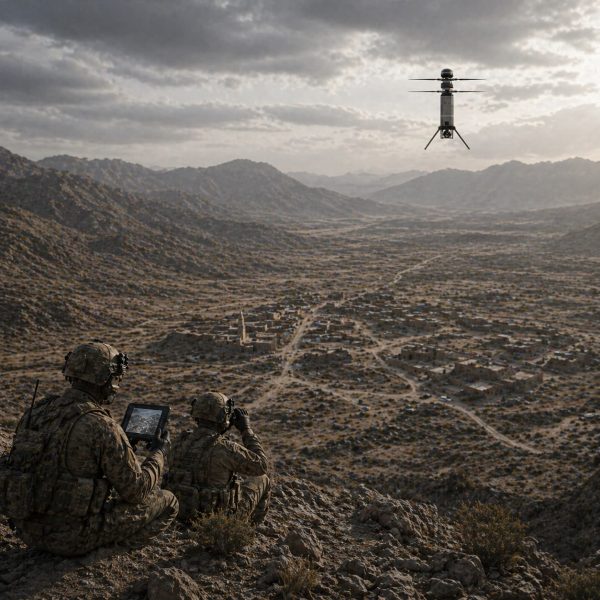
Military planners and system integrators face an increasingly specific problem: small, persistent platforms—often designed as loitering munitions—operate with low signatures and smart autonomy that defeat traditional air surveillance. Observers have noted this in multiple theaters, most prominently during the Russia–Ukraine conflict where loitering systems changed tactical patterns and forced rapid counter-UAV adaptation. Modern coaxial designs complicate that picture; see coaxial drones and the similar profile of a coaxial uav, both of which can shrink radar cross-section and loiter at low altitude while relying on autonomous flight controls. The problem is concrete: detection gaps create time-to-intercept penalties, and those penalties become tactical losses.

Dissecting the Anatomy: Airframe, Sensors, and Autonomy
A loitering platform’s effectiveness comes from three compact subsystems: airframe and propulsion, payload and sensors, and autonomy. Coaxial rotor or small VTOL layouts reduce acoustic and radar signatures while giving stable hover for an EO/IR sensor and a modest payload bay. Autonomous flight controls handle waypoint loitering, target recognition, and sometimes GNSS-denied navigation, which in turn reduces operator workload—and increases surprise. The hardware is simple, the software decisive.
Why Radar Struggles: Signature, Flight Profile, and Electronic Tricks
Radars were built to track fast, reflective targets; loitering drones are slow, low, and faint. Their radar cross-section is small; their flight envelopes hug cluttered backgrounds like urban canyons or tree lines, producing high false-alarm rates. Add GNSS spoofing and intermittent RF silence into the mix and you have a platform that deliberately exploits sensor blind spots. Counter-UAV systems that rely only on a single modality will, politely put it, underperform.
Practical Countermeasures and Smart Design Choices
Mitigation is straightforward in theory and messy in practice: use sensor fusion. Combine ground-based radar with passive RF direction-finding, acoustic arrays, and EO/IR to cross-validate contacts. Machine learning classifiers trained on specific signature sets reduce false positives, but training data must reflect local clutter and coaxial rotor noise—the usual oversight in procurement. Field teams should test solutions in representative environments, not only on open ranges—those neat results rarely survive urban operations. Small operational note—systems that ignore integration into command-and-control workflows often create more alarm than actionable intelligence.

Deployment Lessons and Common Mistakes
Lessons from recent engagements are blunt. First, do not treat loitering munitions like conventional fixed-wing targets; engagement timelines differ. Second, avoid single-sensor dependency—radar-only deployments miss low-RCS VTOL approaches. Third, account for electronic warfare: resilient navigation and anti-spoofing measures matter. Alternatives include layered detection with handheld RF scouts for rapid confirmation, or cheaper acoustic nodes to cue electro-optical systems. The most common procurement error is buying high-spec radar and leaving software and integration as an afterthought; hardware without tuned algorithms is an expensive paperweight.
Three Golden Metrics for Evaluating Detection Strategies
To select or assess systems, use three critical metrics. First, probability of detection at low RCS and low altitude—measured in realistic cluttered environments rather than anechoic ranges. Second, time-to-classify: the window from initial detection to confident threat identification, because loitering munitions can compress decision time. Third, operational false-alarm rate balanced against interception cost—high sensitivity is worthless if it generates constant scrambling. Providers should publish these metrics or allow independent trials; thorough field validation wins over glossy spec sheets. These are the unambiguous measures that align procurement with battlefield needs, and they explain why content on platforms like Military Hub matters for teams choosing systems—practical insight, not platitude. Worth noting.
